Understanding Holiday Pay Laws: You Need To Know This

Holiday pay laws in California often leave workers confused, expecting special treatment for working on important days. But in California, employers are not legally required to offer paid holidays or extra pay for working on a holiday. This surprises a lot of people, but what really sets California apart is how much control employers have over setting their own rules. That means your holiday paycheck depends more on company policy than on state law, and that unexpected flexibility can really work in your favor—if you know what to look for.
Table of Contents
- What Are Holiday Pay Laws In California?
- Why Are Holiday Pay Laws Important For Employees?
- How Holiday Pay Works In Different Employment Situations
- Key Concepts Related To Holiday Pay Laws In California
Quick Summary
| Takeaway | Explanation |
|---|---|
| Employers aren’t required to provide holiday pay. | California law gives employers discretion over holiday pay, meaning no legal obligation exists for paid holidays. |
| Review your employment contract for holiday pay provisions. | It’s essential to check employment documents for specific details regarding holiday compensation rights and provisions. |
| Industry practices vary in holiday compensation. | Different sectors have distinct standards, such as retail and hospitality, impacting holiday pay policies significantly. |
| Union contracts may dictate holiday pay requirements. | Employees in unionized workplaces often benefit from specific stipulations regarding holiday pay in collective bargaining agreements. |
| Understanding holiday pay helps in negotiations. | Knowledge of holiday compensation policies equips employees to negotiate fair pay and benefits during job discussions. |
What Are Holiday Pay Laws in California?
Understanding holiday pay laws in California requires recognizing the unique landscape of employee compensation during holidays. Unlike some states with strict mandates, California provides significant flexibility for employers in determining holiday pay practices. Employers are not legally required to provide paid holidays or extra compensation for working on holidays, which often surprises many workers across the state.
Legal Framework for Holiday Compensation
The California Department of Industrial Relations clarifies that private sector employers have substantial discretion in establishing holiday pay policies. This means companies can independently decide whether to offer paid holidays, holiday premium rates, or additional compensation. While public sector employees might have different regulations, private sector workers must rely on individual employer policies or collective bargaining agreements.
Key Considerations for Holiday Pay
Although California law does not mandate holiday pay, several important factors influence how employers approach holiday compensation:
- Company Policy: Most organizations outline their holiday pay practices in employee handbooks or employment contracts
- Industry Standards: Some sectors, like hospitality and retail, have more established holiday compensation traditions
- Collective Bargaining Agreements: Union contracts might specify specific holiday pay requirements
Workers should carefully review their employment documents to understand their specific holiday compensation rights. Learn more about employee rights in California to ensure you fully understand your workplace protections.

While legal requirements might seem minimal, many progressive California employers recognize the importance of fair holiday compensation as a key strategy for employee retention and workplace satisfaction.
Why Are Holiday Pay Laws Important for Employees?
Holiday pay laws represent more than just financial compensation they are critical markers of workplace fairness and employee respect. While California does not mandate automatic holiday pay, understanding these laws helps workers protect their rights and negotiate fair workplace conditions. Employees benefit from knowing their legal standing regarding holiday compensation, which can significantly impact their overall job satisfaction and economic well being.
Financial Protection and Workplace Equity
The absence of mandatory holiday pay does not diminish its importance. Workers in industries like hospitality, retail, and service sectors often experience unique challenges during holiday periods. Some employees might be required to work when others are celebrating, making holiday compensation a crucial aspect of workplace equity. Explore comprehensive insights into employee rights to better comprehend these nuanced workplace dynamics.
Strategic Considerations for Employees
Employees should be strategic in understanding and negotiating holiday compensation. Key considerations include:
- Contractual Clarity: Review employment contracts for specific holiday pay provisions
- Industry Variations: Recognize that compensation practices differ across sectors
- Negotiation Opportunities: Use knowledge of holiday pay practices as leverage during job interviews or performance reviews
By understanding holiday pay dynamics, workers can make informed decisions about their employment, ensuring they are fairly compensated for their time and commitment. Proactive employees who understand these legal frameworks are better positioned to advocate for themselves and secure equitable workplace conditions.
Ultimately, while California law provides employers flexibility, informed employees can transform potential limitations into opportunities for fair workplace negotiations.
How Holiday Pay Works in Different Employment Situations
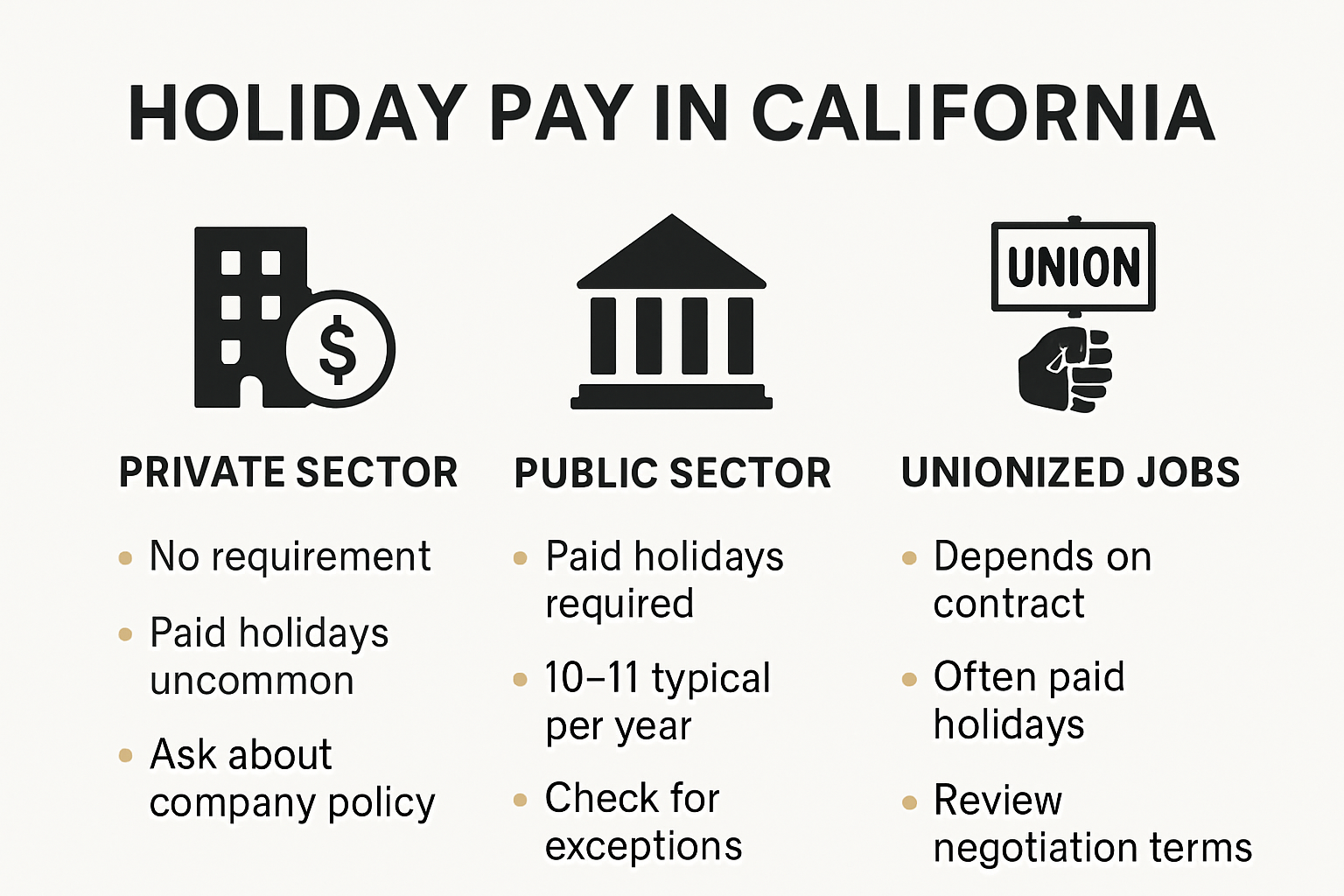
Holiday pay varies dramatically across different employment sectors in California, reflecting the complexity of workplace compensation practices. Understanding these nuanced differences is crucial for employees navigating their specific work environments. Each industry and employment type presents unique considerations for holiday compensation, making it essential for workers to comprehend their potential entitlements.
To help readers quickly compare how holiday pay policies differ by employment sector in California, the following table summarizes key characteristics mentioned in the article.
| Employment Type | Holiday Pay Requirement | Who Sets Policy | Common Practices |
|---|---|---|---|
| Private Sector (Non-Union) | Not legally required | Individual employer | Varies; outlined in company policies |
| Private Sector (Unionized) | Not legally required by law, but may be required by contract | Collective bargaining agreement | Often includes specific holiday provisions |
| Public Sector (Government) | Typically required by internal policy or law | Government employer | Standardized holiday pay and time off |
| Healthcare/Emergency Services | Not legally required | Employer/industry practice | Often higher rates or compensatory time off |
| Retail/Hospitality | Not legally required | Employer/industry tradition | Some offer premium holiday pay, others none |
Private Sector Employment Dynamics
In private sector settings, holiday pay is entirely at the discretion of employers. Companies develop their own policies, which can range from providing no holiday pay to offering generous compensation packages. Retail, hospitality, and service industries often have distinct approaches, with some businesses providing holiday premium rates or compensatory time off. Learn more about navigating workplace compensation rules to better understand these complex payment structures.
Sector Specific Holiday Pay Considerations
Different employment sectors demonstrate remarkable variations in holiday compensation practices:
- Unionized Workplaces: Collective bargaining agreements frequently stipulate specific holiday pay provisions
- Public Sector Jobs: Government employees typically have more standardized holiday pay regulations
- Hourly vs Salaried Positions: Compensation structures significantly impact holiday pay entitlements
Some industries, like healthcare and emergency services, require continuous operations during holidays. These sectors often implement specialized compensation strategies, such as higher hourly rates or additional time off to compensate employees working during traditional holiday periods.
Employees should carefully review their employment contracts, company handbooks, and discuss holiday compensation directly with human resources to fully understand their specific workplace provisions. Proactive communication and understanding can help workers make informed decisions about their employment and potential compensation opportunities.
Key Concepts Related to Holiday Pay Laws in California
Navigating holiday pay laws in California requires understanding a complex landscape of workplace compensation regulations. The state provides employers significant discretion in designing holiday pay practices, creating a nuanced environment where workers must be proactive in understanding their rights and potential compensation structures. Learn more about essential employment rights to better comprehend these intricate legal frameworks.
Fundamental Legal Principles
Unlike some states with strict holiday pay mandates, California employment law allows remarkable flexibility for employers. The fundamental principle is that holiday pay is not a legal requirement but a voluntary benefit determined by individual employer policies, collective bargaining agreements, or employment contracts. This approach means that compensation for holiday work varies dramatically across different industries and organizational cultures.
Critical Compensation Considerations
Employees should be aware of several key concepts that shape holiday pay dynamics in California:
Here is a quick-reference table defining key concepts related to holiday pay laws in California, as described in the article.
| Key Concept | Definition |
|---|---|
| Holiday Pay Policy | Rules set by employers outlining if and how holiday pay is given |
| Collective Bargaining Agreement | Union contract that can stipulate specific holiday pay terms |
| Industry Standard | Typical practice within a sector regarding holiday compensation |
| Voluntary Benefit | Employer chooses (not required by law) to provide holiday pay |
| Contractual Provision | Specific language in a contract about holiday pay rights |
- Voluntary Compensation: Employers are not legally obligated to provide holiday pay or premium rates
- Contractual Specifics: Holiday pay provisions must be explicitly outlined in employment agreements
- Industry Variations: Different sectors develop unique approaches to holiday compensation
Some employers choose to offer holiday pay as a strategic tool for employee retention and workplace morale. While not mandated by law, these practices can significantly impact an employee’s overall compensation package and job satisfaction. Workers should carefully review their specific employment documents to understand their particular holiday pay provisions and potential entitlements.
Understanding these key concepts empowers employees to make informed decisions about their workplace compensation and negotiate effectively within California’s flexible legal framework.
Protect Your Rights When Holiday Pay Is Denied
Many California workers are shocked to discover that holiday pay is not guaranteed by law. If you have questions about your rights, struggle with unclear company policies, or believe you are unfairly denied holiday compensation, you are not alone. Feeling powerless when you work through the holidays without fair pay is frustrating, especially when the law allows employers so much flexibility. Your peace of mind should not depend on confusing workplace rules or inconsistent company handbooks.
You do not have to accept uncertainty or unfair treatment regarding your wages. Our experienced California employment lawyers help employees enforce their rights and recover what they are owed. Find out how the California Employment Law team at Huprich Law Firm can guide you, answer your questions, and stand up for your interests. Take control of your situation and ask for a confidential case evaluation today. Visit Huprich Law Firm now to get started and gain the workplace protection you deserve.
Frequently Asked Questions
What are the holiday pay laws in California?
In California, there is no legal requirement for employers to provide paid holidays or additional compensation for working on holidays. Employers have significant discretion in establishing their holiday pay policies.
Are employers required to pay extra for working on holidays in California?
No, California law does not mandate additional compensation for employees who work on holidays. Companies can choose their own policies regarding holiday pay.
How can I find out about my holiday pay entitlements?
Employees should review their employment contracts, company handbooks, and discuss with their human resources department to understand their specific holiday pay provisions and entitlements.
Do different industries have varying holiday pay practices in California?
Yes, holiday pay practices can vary widely across different sectors. Some industries, like retail or hospitality, may have established traditions of offering holiday pay, while others may not.
Recommended
- Employee Benefits California: What You Need To Know
- Employment Law Basics 2025: What You Need To Know
- California Wage Theft Laws 2025 You Need To Know
- Overtime Laws in California 2025: You Need To Know This
- A Recap of California Employment Law in 2024
https://huprichlaw.com/understanding-holiday-pay-laws-california/?fsp_sid=2646


Comments
Post a Comment