Retaliation For Reporting In Pomona You Need To Know

Working in Pomona warehouses and industrial facilities means facing real safety risks every day. When you report violations like blocked exits, faulty equipment, or dangerous conditions, you expect your employer to fix the problem. Instead, many workers face retaliation that affects 25% of wrongful termination claims in California. You have strong legal protections under state law in 2026, and understanding these rights can mean the difference between losing your job and holding your employer accountable. This guide explains exactly what protections you have, how to recognize retaliation, and what steps to take when your employer punishes you for doing the right thing.
Table of Contents
- Understanding Retaliation For Reporting Safety Violations In Pomona Warehouses
- Legal Protections And Rights Under California Law In 2026
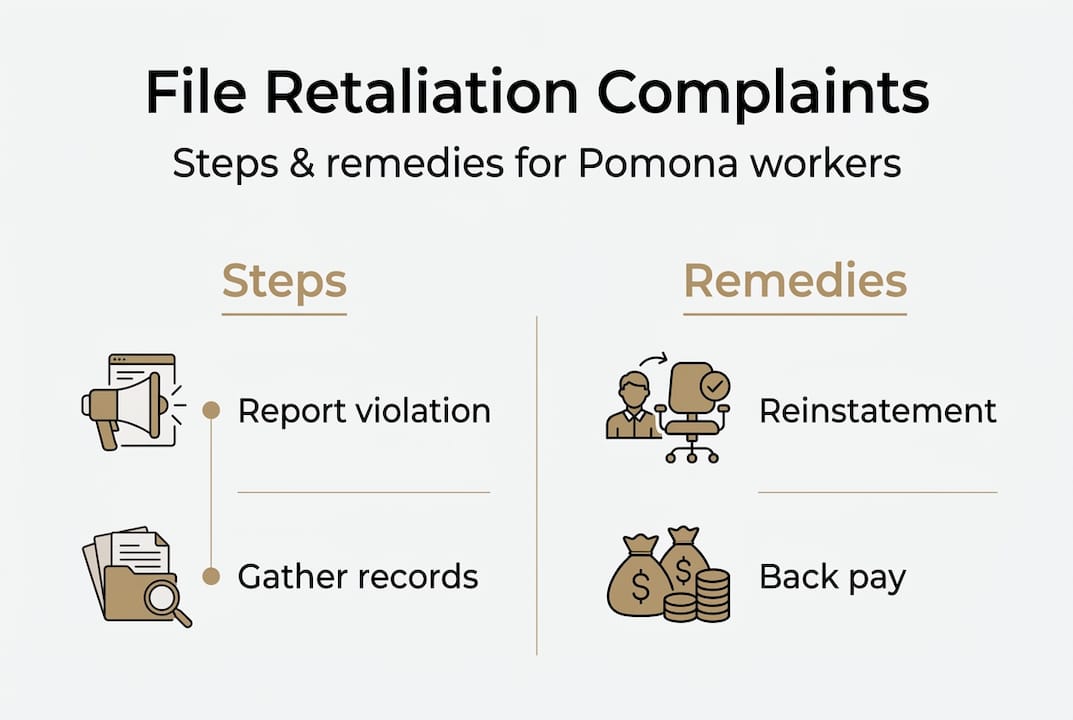
- How To File Retaliation Complaints And Seek Remedies In Pomona
- Special Considerations For Temporary And Contract Workers In Pomona Warehouses
- Protect Your Rights With Experienced Pomona Employment Lawyers
- Frequently Asked Questions
Key takeaways
| Point | Details |
|---|---|
| Retaliation takes many forms | Beyond firing, watch for demotions, hostile treatment, reduced hours, unfair write-ups, and sudden shift changes after reporting safety issues. |
| Strong legal protections exist | California Labor Code §1102.5 shields you from retaliation with a reasonable belief standard and burden-shifting proof requirements favoring employees. |
| Strict filing deadlines apply | You have 6 months for Cal/OSHA or DLSE complaints, or up to 3 years for civil lawsuits seeking full damages and reinstatement. |
| Temp workers have rights too | Temporary employees are protected when client companies control working conditions, creating joint liability for retaliation. |
| Document everything immediately | Keep records of safety reports, employer responses, and any adverse actions to build your case and meet tight deadlines. |
Understanding retaliation for reporting safety violations in Pomona warehouses
Retaliation happens when your employer punishes you for reporting safety violations, filing complaints, or refusing to work in dangerous conditions. In Pomona’s high-volume warehouses along Mission Boulevard and industrial zones near the 60 freeway, workers face constant pressure to meet productivity targets even when safety equipment fails or hazards go unaddressed. When you speak up, retaliation can strike fast.
Common forms include:
- Immediate termination or layoff shortly after filing a complaint
- Demotion to lower-paying positions or less desirable roles
- Drastic reduction in scheduled hours or shift assignments
- Hostile treatment from supervisors who previously treated you fairly
- Sudden disciplinary write-ups for minor issues previously ignored
- Forced transfers to worse locations or undesirable departments
- Exclusion from training opportunities or advancement paths
Pomona’s warehouse sector carries elevated risk because high injury rates create more opportunities for workers to witness and report violations. Employers sometimes retaliate subtly, making it look like performance issues or business needs drove the adverse action. You might notice your supervisor suddenly documenting every small mistake, or coworkers receiving preferential treatment while you face increased scrutiny.
State agencies receive over 7,500 retaliation complaints yearly, with roughly 25% of California wrongful termination claims involving safety retaliation in warehouse and industrial settings.
Recognizing these patterns early matters because California law protects you, but only if you act within specific timeframes. Retaliation doesn’t always mean getting fired on the spot. Watch for changes in how management treats you, especially if the timing coincides with your safety complaint. Understanding signs of workplace retaliation helps you identify problems before they escalate and preserves your ability to take legal action.
Legal protections and rights under California law in 2026
California provides some of the nation’s strongest whistleblower protections for employees who report safety violations. Labor Code §1102.5 protects workers from retaliation when they report violations of state or federal law, including workplace safety rules, to internal management, government agencies, or law enforcement. You don’t need absolute proof that a violation occurred. The law protects you if you have a reasonable belief that your employer violated safety regulations.
The reasonable belief standard means you’re protected even if an investigation later finds no violation, as long as you genuinely believed the safety issue was real based on the facts you knew. This protection extends to:
- Reporting violations to your supervisor or HR department
- Filing complaints with Cal/OSHA or other regulatory agencies
- Refusing to participate in activities you reasonably believe violate safety laws
- Testifying in investigations or legal proceedings about safety violations
- Assisting coworkers who report safety concerns
California uses a burden-shifting framework that favors employees in retaliation cases. You must show that reporting the safety violation was a contributing factor in your employer’s decision to take adverse action against you. The timing between your complaint and the retaliation often provides strong evidence. Once you establish this connection, the burden shifts to your employer to prove by clear and convincing evidence that they would have taken the same action even without your safety report.
This legal structure gives you significant leverage. Employers can’t simply claim they fired you for poor performance if the timing and circumstances suggest retaliation. They must demonstrate convincing evidence that legitimate business reasons, completely independent of your protected activity, drove their decision.
The law protects most workers, including temporary employees when client companies control their working conditions. Limited exceptions exist for elected officials and specific government positions. You have a 3-year statute of limitations to file a civil lawsuit under this code, giving you more time than administrative complaints but requiring careful attention to deadlines.
Pro Tip: Start documenting the moment you report a safety violation. Keep copies of written complaints, emails, text messages, and notes about verbal conversations including dates, times, and witnesses. Photograph safety hazards if possible. This documentation becomes crucial evidence if your employer retaliates.

Understanding your rights under whistleblower protection laws and California employment retaliation law empowers you to stand up for workplace safety without fear. These protections exist specifically because lawmakers recognized that workers need strong shields against employer punishment when they expose dangerous conditions that put lives at risk.
How to file retaliation complaints and seek remedies in Pomona
When you face retaliation for reporting safety violations, you have multiple paths to seek justice and compensation. Understanding the processes, deadlines, and potential outcomes helps you choose the right approach for your situation.
California offers three main complaint processes:
- Cal/OSHA complaints: File directly with California’s Division of Occupational Safety and Health when retaliation involves workplace safety issues. Cal/OSHA investigates and can order remedies.
- DLSE complaints under Labor Code §6310: The Division of Labor Standards Enforcement handles retaliation complaints related to occupational safety violations with enforcement authority.
- Civil lawsuits: File directly in court under Labor Code §1102.5 or other applicable statutes, seeking full damages and legal remedies through litigation.
Each process has strict deadlines and different potential outcomes:
| Process | Filing deadline | Potential remedies | Key advantage |
|---|---|---|---|
| Cal/OSHA | 6 months | Reinstatement, back pay, penalties | Fast investigation, no attorney required |
| DLSE §6310 | 6 months | Back pay, reinstatement, penalties | Administrative process, state enforcement |
| Civil lawsuit | 3 years | Full damages, punitive awards, attorney fees | Comprehensive relief, jury trial option |
The 6-month deadline for administrative complaints requires immediate action. Missing this window doesn’t eliminate all options since civil lawsuits allow three years, but administrative processes often resolve faster and cost less initially.
Follow these essential steps after experiencing retaliation:
- Document everything immediately, including the safety violation you reported, when you reported it, who you told, and all subsequent adverse actions against you.
- Report the retaliation internally through your company’s HR department or complaint procedures, creating an official record.
- Consult an employment lawyer experienced in retaliation cases to evaluate your options and ensure you meet all deadlines.
- File your complaint with the appropriate agency or court within the required timeframe, including all supporting documentation.
- Preserve all evidence including emails, text messages, photos, witness contact information, and performance reviews.
- Continue documenting any ongoing retaliation or hostile treatment that occurs after filing your complaint.
Successful retaliation claims can result in substantial remedies. Courts and agencies can order:
- Reinstatement to your former position with the same pay and benefits
- Back pay covering all lost wages from the retaliation date forward
- Emotional distress damages compensating for anxiety, humiliation, and mental suffering
- Punitive damages punishing particularly egregious employer conduct
- Attorney fees and costs reimbursing your legal expenses
Pro Tip: Don’t wait to see if the situation improves. Strict deadlines mean delay can cost you the right to file certain complaints. Consult a lawyer immediately after retaliation occurs, even if you’re unsure whether you have a strong case. Early legal advice protects your options.
Understanding how to prove retaliation and your whistleblower retaliation rights ensures you take the right steps at the right time. The complaint process may seem intimidating, but these procedures exist specifically to protect workers like you who face punishment for reporting dangerous conditions.
Special considerations for temporary and contract workers in Pomona warehouses
Temporary and contract workers make up a significant portion of Pomona’s warehouse workforce, especially in high-volume distribution centers and logistics facilities. If you work through a staffing agency, you might wonder whether whistleblower protections apply to you. The answer is yes, with important nuances about who bears responsibility for retaliation.
Temporary workers receive protection when client companies control their working conditions under California law and OSHA’s multi-employer doctrine. This means if the warehouse or industrial facility where you actually work directs your daily activities, sets your schedule, and controls your work environment, that client company can be held liable for retaliating against you even though a staffing agency technically employs you.
Legal responsibilities split between staffing agencies and client companies:
| Responsibility | Staffing agency | Client company |
|---|---|---|
| Paying wages | Primary responsibility | Joint liability possible |
| Workplace safety | Shared duty | Primary control and liability |
| Retaliation liability | Yes, if involved in decision | Yes, if controls working conditions |
| Investigation cooperation | Required | Required |
This joint employer framework protects you from situations where companies try to avoid liability by claiming the other party made the decision. If the client company tells your staffing agency to remove you after you report safety violations, both can face liability. The key factor is who exercised control over your work environment and had the power to correct the safety violation you reported.
Temporary workers face unique challenges that make retaliation particularly harmful:
- Job insecurity and fear of losing future assignments if labeled a troublemaker
- Pressure from staffing agencies to avoid complaints that might damage client relationships
- Uncertainty about which company to report safety violations to
- Concerns that speaking up will result in no longer receiving work assignments
- Limited access to the same complaint procedures available to direct employees
Despite these pressures, your legal protections remain strong. You cannot be punished for reporting legitimate safety concerns, regardless of your employment status. The law recognizes that temporary workers often face the most dangerous conditions precisely because they lack job security and fear retaliation.
Pro Tip: If you’re a temporary worker, understand that both your staffing agency and the client company where you work may qualify as your employer for retaliation purposes. Don’t let either company tell you they’re not responsible. Consult an attorney who can evaluate the specific control each entity exercised over your work.
Knowing your rights helps overcome the intimidation temporary workers often feel. The same retaliation protections that shield permanent employees apply to you. Companies cannot use temporary employment status as a shield against liability when they punish workers for reporting dangerous conditions that threaten everyone’s safety.
Protect your rights with experienced Pomona employment lawyers
Navigating retaliation claims requires understanding complex legal standards, gathering compelling evidence, and meeting strict deadlines that can determine whether you receive justice. Employment lawyers who focus on worker rights know how to build strong cases that hold employers accountable for punishing employees who report safety violations. If you’re facing retaliation in Pomona’s warehouses or industrial facilities, professional legal guidance can make the difference between losing your case and securing full compensation.
Huprich Law offers free consultations for warehouse and industrial workers experiencing retaliation. We understand the specific challenges you face in Pomona’s logistics and manufacturing sectors, and we’re committed to protecting your rights under California’s whistleblower laws. Our team has extensive experience with retaliation cases and knows how to navigate both administrative complaints and civil litigation. Learn more about reasons to hire an employment lawyer and explore your options through our employee lawyers free consultation services. We serve workers throughout Southern California with deep knowledge of employment law protections in Los Angeles and surrounding areas, ensuring you receive experienced advocacy when your employer retaliates against you for doing the right thing.
Frequently asked questions
What are the signs of retaliation after reporting safety violations?
Retaliation can include firing, demotion, hostile treatment, scheduling changes, and disciplinary write-ups that occur shortly after you report safety issues. Watch for sudden changes in how supervisors treat you, especially if you previously had good performance reviews. Other signs of workplace retaliation include exclusion from meetings, denial of training opportunities, or transfer to less desirable positions. The timing between your safety report and adverse actions provides crucial evidence of retaliation.
How long do I have to file a retaliation complaint in California?
Most retaliation complaints to Cal/OSHA or DLSE must be filed within 6 months of the retaliatory action. Civil lawsuits under Labor Code §1102.5 have a 3-year statute of limitations, giving you more time but requiring careful attention to deadlines. Missing the 6-month administrative deadline doesn’t eliminate all options, but it closes certain paths to relief. Acting quickly preserves your maximum legal options and helps build stronger evidence while events remain fresh. Understanding how to prove retaliation requires meeting these strict timeframes.
Are temporary workers protected against retaliation in warehouses?
Temporary workers receive full protection if the client company controls their work environment and daily activities. California law and OSHA’s multi-employer doctrine recognize that client companies directing your work bear responsibility for retaliation even when a staffing agency technically employs you. Both entities can face joint liability when they coordinate to punish you for reporting safety violations. Your temporary status doesn’t reduce your rights under whistleblower protection laws. Learn more about retaliation protections that apply regardless of employment classification.
What remedies can I get if retaliation is proven?
You may be entitled to reinstatement to your former position, back pay covering all lost wages, and compensation for emotional distress caused by the retaliation. Courts can also award punitive damages when employer conduct was particularly egregious, along with attorney fees and costs. These remedies aim to make you whole and deter future retaliation. The specific damages depend on your case’s facts, including how long the retaliation lasted and its impact on your career and wellbeing. Understanding your full whistleblower retaliation rights helps you seek appropriate compensation for the harm you suffered.
Recommended
- Retaliation in Charter Oak: What You Need to Know
- Retaliation for Reporting Harassment You Need To Know
- Workplace Retaliation and Investigations: Monterey Park Guide You Need To Know
- Whistleblower Retaliation California: What You Need To Know
https://huprichlaw.com/retaliation-for-reporting-safety-violations-in-pomona-2026-rights/?fsp_sid=2662


Comments
Post a Comment