Workplace Harassment Laws For Glendale You Need To Know

Studies show that nearly 70% of employees who experience harassment never report it, often due to fear or confusion about their rights. If you work in Glendale and face harassment, understanding California’s workplace protections can be the difference between suffering in silence and taking action. This guide explains the laws that protect you, your rights as an employee, and practical steps to hold harassers and negligent employers accountable.
Table of Contents
- Understanding Workplace Harassment Under California Law
- Employee Legal Rights And Protections In Glendale
- Employer Responsibilities And Enforcement Obligations
- How To Report Workplace Harassment In Glendale
- Common Misconceptions About Workplace Harassment Laws
- Legal Remedies And Support For Harassment Victims
- Get Expert Legal Help With Workplace Harassment In Glendale
- Frequently Asked Questions About Workplace Harassment Laws In Glendale
Key takeaways
| Point | Details |
|---|---|
| FEHA protects employees | California’s Fair Employment and Housing Act covers harassment based on race, gender, religion, disability, sexual orientation, and many other categories beyond just sexual harassment. |
| Employers must act | California law requires harassment prevention training, prompt investigations, and immediate corrective actions when harassment is reported. |
| Reporting deadlines matter | File complaints with California DFEH within 1 year or EEOC within 180 days to preserve your legal rights and options. |
| Legal remedies available | Victims can recover damages for emotional distress and lost wages, secure injunctions, and negotiate settlements with employer support. |
| Free legal help exists | Many employment lawyers offer free consultations and work on contingency fees, eliminating upfront costs for harassment victims. |
Understanding workplace harassment under California law
California’s Fair Employment and Housing Act defines harassment to include unwelcome verbal, physical, and visual conduct that targets protected characteristics. Unlike federal laws, FEHA protects employees in far more categories, giving you broader legal coverage. You need to recognize what counts as illegal harassment to know when your rights are violated.
FEHA covers harassment based on these protected categories:
- Race, color, or national origin
- Gender, gender identity, and gender expression
- Sexual orientation
- Religion or religious creed
- Age (40 and over)
- Disability (physical or mental)
- Marital status
- Medical condition
- Genetic information
- Military or veteran status
Harassment takes many forms in the workplace. Offensive jokes about someone’s religion, racial slurs, unwanted touching or physical intimidation, sexually explicit images or comments, mocking someone’s disability, and repeated derogatory remarks about gender identity all qualify. The conduct must be severe or pervasive enough to create a hostile work environment that interferes with your ability to do your job.
Recognizing workplace harassment in California is the first step toward protecting yourself. A single extremely serious incident or a pattern of repeated offensive behavior can both meet the legal threshold. You do not have to tolerate harassment simply because it seems minor or infrequent.
Pro Tip: Document every harassment incident immediately with dates, times, witnesses, and exact words or actions. Your detailed records become critical evidence if you pursue legal action.
Employee legal rights and protections in Glendale
You have powerful legal protections under California law that many employees do not realize exist. FEHA applies to employers with five or more employees, a much lower threshold than federal laws that typically require 15 or more. This means most Glendale workplaces fall under FEHA’s broad protections, giving you stronger rights than federal law alone provides.
Your rights as a Glendale employee include:
- The right to work in an environment free from harassment and discrimination based on protected characteristics.
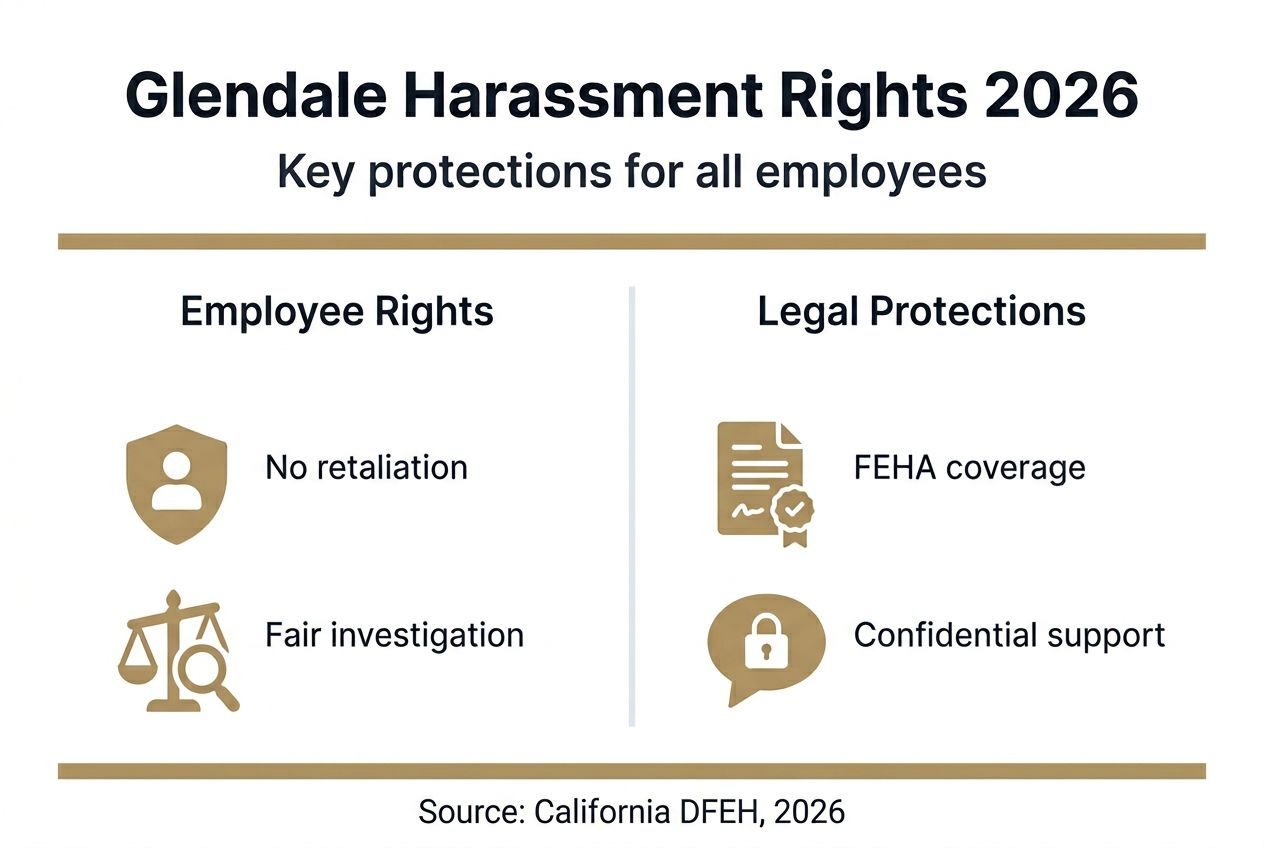
- The right to report harassment without fear of retaliation, including termination, demotion, or hostile treatment.
- The right to demand a thorough investigation when you report harassment to your employer.
- The right to participate in harassment investigations or legal proceedings without employer retaliation.
- The right to file complaints with state and federal agencies if your employer fails to address harassment.
California’s anti-retaliation laws provide strong protections for employees who speak up. If you report harassment or participate in an investigation, your employer cannot legally fire you, demote you, cut your pay, or create a hostile environment in response. Retaliation protections extend to employees who support coworkers facing harassment, not just direct victims.
Understanding these rights empowers you to take action without fear. Many employees remain silent because they believe complaining will cost them their job. California law specifically prohibits this outcome and provides legal remedies if retaliation occurs. Whistleblower protections in California reinforce your ability to report illegal conduct safely.
Pro Tip: Keep copies of all employment documents including your offer letter, handbook, performance reviews, and pay stubs at home. If you face retaliation after reporting harassment, these documents prove your job status before you complained.
Employer responsibilities and enforcement obligations
California law places strict requirements on employers to prevent and address harassment. Your employer cannot simply react after harassment occurs. They must take proactive steps to create a harassment-free workplace and respond immediately when problems arise. Understanding what your employer must do helps you recognize when they fail to meet legal obligations.

California law mandates harassment prevention training for all employees and supervisors, with specific requirements for content and frequency. Supervisors must complete at least two hours of training within six months of assuming supervisory roles, then every two years afterward. Non-supervisory employees must receive at least one hour of training. This training must cover harassment based on all FEHA protected categories, not just sexual harassment.
Employers must take these actions when harassment is reported:
- Conduct a prompt, thorough, and impartial investigation into all harassment complaints
- Interview the complainant, accused harasser, and all potential witnesses
- Review relevant documents, emails, text messages, and other evidence
- Take immediate interim measures to separate the parties and prevent ongoing harassment during investigation
- Determine whether harassment occurred based on a preponderance of evidence
- Implement corrective actions immediately if harassment is substantiated
Corrective actions must be appropriate to stop the harassment and prevent recurrence. Depending on severity, this can include verbal or written warnings, mandatory training, reassignment, suspension, demotion, or termination of the harasser. Your employer cannot take token actions or ignore substantiated harassment.
Employers face significant legal liability when they fail to investigate complaints, take insufficient corrective action, or allow harassment to continue. You can hold your employer accountable for harassment through legal action if they breach these duties. Courts may award substantial damages against employers who knew about harassment but failed to act.
Pro Tip: If your employer’s investigation seems rushed, one-sided, or dismissive, document these failures in detail. Inadequate investigations can strengthen your legal case by proving your employer did not take harassment seriously.
How to report workplace harassment in Glendale
Taking the right steps when you report harassment protects your legal rights and strengthens any future claims. Follow these procedures carefully to create a strong record and maximize your chances of resolution.
- Report the harassment to your employer’s HR department or designated complaint recipient as soon as possible. Use written communication like email to create a permanent record.
- Follow any internal complaint procedures outlined in your employee handbook, but do not let complex procedures delay your report.
- Keep copies of your complaint, all employer responses, and any communications about the investigation at home, not just on your work computer.
- If your employer fails to investigate or take corrective action within a reasonable time, escalate your complaint to higher management or company leadership.
- If internal reporting fails to resolve the harassment, file a complaint with California DFEH within 1 year of the last harassment incident.
- Alternatively or simultaneously, file an EEOC charge within 180 days after the harassment occurred.
Timelines matter significantly. California DFEH complaints must be filed within one year, while EEOC complaints require filing within 180 days. Missing these deadlines can permanently bar your legal claims, regardless of how serious the harassment was. Act quickly to preserve all options.
Strong documentation makes the difference between successful and unsuccessful harassment claims. Keep detailed records including:
- Dates, times, and locations of every harassment incident
- Exact words spoken or actions taken by the harasser
- Names and contact information of anyone who witnessed the harassment
- Your emotional and physical reactions to each incident
- All emails, text messages, or other communications related to the harassment
- Names and dates of everyone you reported the harassment to
- Your employer’s response or lack of response to your complaints
Documenting workplace harassment in California creates contemporaneous evidence that courts and agencies find highly credible. Write down details immediately after each incident while your memory is fresh. Even brief notes with specific facts are valuable.
Pro Tip: Send yourself a detailed email after each harassment incident describing what happened. The email’s timestamp proves you documented the harassment in real time, making it harder for anyone to claim you fabricated details later.
Common misconceptions about workplace harassment laws
Many Glendale employees hesitate to report harassment because they believe myths that simply are not true. Understanding the facts helps you make informed decisions about protecting your rights.
Myth 1: Only sexual harassment counts as illegal workplace harassment. FEHA protects employees from harassment based on race, religion, disability, age, and many other categories beyond sex or gender. Racial slurs, religious discrimination, disability mocking, and age-based hostility all violate California law just as seriously as sexual harassment. The law makes no hierarchy of which harassment types matter more.
Myth 2: Reporting harassment always leads to retaliation and job loss. California law strictly prohibits retaliation against employees who report harassment or participate in investigations. If your employer retaliates, you have additional legal claims beyond the original harassment. Many employees successfully report harassment and continue working without retaliation, especially when employers follow the law.
Myth 3: Federal laws cover all employees, so state laws do not matter. FEHA covers employers with five employees, while federal laws typically require 15 or more. California law provides broader protections, more protected categories, and stronger remedies than federal statutes. Relying only on federal law means missing significant rights available under California law.
Myth 4: You must prove the harassment was severe to have a valid claim. California law covers harassment that is either severe or pervasive. A single extremely serious incident or a pattern of repeated offensive behavior can both create a hostile work environment. You do not need to show the harassment was unbearable or caused serious psychological harm, just that it was unwelcome and based on a protected characteristic.
Clearing these misconceptions encourages more employees to stand up for their rights. Many valid harassment claims go unreported because workers believe false information about their legal protections and options. Understanding what workplace harassment actually means empowers you to recognize when you experience illegal conduct.
Legal remedies and support for harassment victims
When you pursue legal action for workplace harassment, California law provides multiple remedies to compensate you and prevent future harassment. Understanding available options helps you make informed decisions about how to proceed.
Victims of workplace harassment may recover several types of damages:
- Compensatory damages for emotional distress, anxiety, depression, and mental anguish caused by harassment
- Lost wages and benefits if harassment caused you to miss work or forced you to resign
- Future lost earnings if harassment damaged your career prospects or ability to work
- Medical expenses for therapy, counseling, or treatment related to harassment trauma
- Punitive damages against employers who acted with malice or reckless indifference
Courts can also issue injunctions requiring your employer to stop specific harassment, implement new policies, provide additional training, or take other corrective measures. These remedies protect you and other employees from ongoing harassment even if you continue working there.
Many harassment cases settle before trial. Settlements allow you to negotiate compensation, confidentiality terms, employment terms, and other provisions that meet your specific needs. An experienced lawyer helps you evaluate whether settlement offers are fair or whether proceeding to trial serves your interests better.
| Remedy Type | Description | Timeline |
|---|---|---|
| Compensatory Damages | Money for emotional distress, lost wages, medical costs | Determined at trial or settlement |
| Punitive Damages | Additional money to punish employer for egregious conduct | Awarded in cases of malice or recklessness |
| Injunctive Relief | Court orders requiring employer to change policies or practices | Immediate upon court order |
| Attorney Fees | Employer pays your legal costs if you win | Awarded after successful verdict |
Accessing legal help for workplace issues in California is easier than many employees realize. Most employment lawyers offer free initial consultations where you can discuss your situation confidentially and learn about your options without financial commitment. Many also work on contingency fees, meaning you pay nothing unless they recover money for you.
Timely legal support significantly improves your chances of fair outcomes. Lawyers help you navigate complex procedures, meet critical deadlines, gather strong evidence, and negotiate effectively with employers who have their own attorneys. There are many reasons to hire an employment lawyer rather than handling harassment claims alone.
Get expert legal help with workplace harassment in Glendale
Navigating California’s workplace harassment laws requires specialized knowledge that most employees lack. Professional legal assistance protects your rights, strengthens your case, and maximizes your chances of achieving fair compensation and justice. Experienced Glendale employment lawyers understand exactly how to build strong harassment claims and negotiate with employers who have legal teams defending them.
You should not face workplace harassment alone. Legal professionals can evaluate your situation, explain your options, handle all communications with your employer, file timely complaints with appropriate agencies, gather and preserve critical evidence, and represent you in negotiations or court proceedings. Employment law protections in Los Angeles and surrounding areas like Glendale provide powerful tools, but only when used correctly.
Many harassment victims delay seeking legal help because they worry about costs. Free consultations allow you to discuss your case confidentially and learn about your rights without any financial obligation. When you get legal help for workplace issues, you gain an advocate who fights for your interests while you focus on your wellbeing and career.
The decision to hire an employment lawyer becomes easier when you understand that many work on contingency fees. You pay nothing upfront and nothing unless your lawyer recovers money for you. This arrangement aligns your lawyer’s interests with yours and makes justice accessible regardless of your financial situation.
Frequently asked questions about workplace harassment laws in Glendale
What types of behavior count as workplace harassment in California?
Workplace harassment includes unwelcome verbal, physical, or visual conduct based on protected characteristics like race, gender, religion, disability, age, or sexual orientation. Examples include offensive jokes, slurs, inappropriate touching, sexually explicit images, and repeated derogatory comments. The behavior must be severe or pervasive enough to create a hostile work environment.
How long do I have to report workplace harassment in Glendale?
You should report harassment to your employer immediately to create a record and trigger their duty to investigate. For legal claims, you must file with California DFEH within one year or EEOC within 180 days of the last incident. Missing these deadlines can permanently bar your claims regardless of severity.
Can my employer fire me for reporting harassment?
No. California law strictly prohibits retaliation against employees who report harassment, participate in investigations, or file legal complaints. If your employer fires, demotes, or otherwise punishes you for reporting harassment, you have additional legal claims for retaliation beyond the original harassment claim.
What is the difference between California and federal harassment laws?
California’s FEHA covers employers with five or more employees, while federal laws typically require 15 or more. FEHA also protects more categories, provides longer filing deadlines, and offers stronger remedies. California employees have broader rights under state law than federal law alone provides.
Do I need a lawyer to file a workplace harassment complaint?
You can file complaints with DFEH or EEOC yourself, but having a lawyer significantly improves your chances of success. Lawyers help you meet deadlines, gather strong evidence, navigate complex procedures, and negotiate effectively. Many offer free consultations and work on contingency fees, making legal help accessible.
What damages can I recover in a workplace harassment case?
You may recover compensatory damages for emotional distress and lost wages, punitive damages if your employer acted with malice, medical expenses for therapy or treatment, and attorney fees if you win. Courts can also issue injunctions requiring your employer to stop harassment and implement corrective measures.
Recommended
- Sexual Harassment by Supervisors in Burbank You Need To Know
- Whistleblower Protections in Glendora: You Need To Know This
- Workplace Bullying Laws California: What You Need To Know
- Understanding Workplace Harassment Laws: What You Need To Know
https://huprichlaw.com/workplace-harassment-laws-glendale-employees/?fsp_sid=2622


Comments
Post a Comment