Sexual Harassment in Glendale: What You Need To Know

Many employees in Glendale corporate offices assume they have limited recourse when facing sexual harassment, or that proving employer liability requires termination or direct supervisor involvement. In reality, California FEHA and federal Title VII provide robust protections, holding employers strictly liable for supervisor harassment regardless of whether management knew about it. Understanding these protections, how to document incidents properly, and the clear steps to report harassment can transform confusion into confident legal action. This guide walks you through your rights under 2026 law, practical documentation strategies, employer liability rules, and how to connect with experienced Glendale employment lawyers who work on contingency fees.
Table of Contents
- Legal Protections Against Sexual Harassment For Glendale Corporate Employees
- How To Document And Report Sexual Harassment In Glendale Corporate Offices
- Understanding Employer Liability And Retaliation In Sexual Harassment Cases
- Legal Options And Resources For Glendale Employees Facing Sexual Harassment
- Find Experienced Glendale Sexual Harassment Lawyers To Protect Your Rights
Key takeaways
| Point | Details |
|---|---|
| Strong legal protections | California FEHA and federal Title VII shield Glendale employees from sexual harassment with strict employer liability for supervisor misconduct. |
| Documentation is critical | Record dates, times, witnesses, and specific behaviors; save emails and texts to build a strong case. |
| Report internally first | File complaints with HR or designated officers, then escalate to California Civil Rights Department within 3 years if unresolved. |
| Retaliation is prohibited | Employers cannot demote, fire, or harass you for reporting harassment, even if your claim is not proven. |
| Legal help is accessible | Glendale employment lawyers often work on contingency fees, meaning no upfront costs and payment only if you win. |
Legal protections against sexual harassment for Glendale corporate employees
Employees in Glendale corporate offices are protected under California FEHA and federal Title VII against sexual harassment, with employers strictly liable for supervisor harassment. This means if a supervisor engages in unwelcome sexual advances, requests for sexual favors, or other verbal or physical conduct of a sexual nature, your employer can be held responsible even if they were unaware of the behavior or took no action to prevent it. The strict liability standard for supervisor harassment sets California apart from many other jurisdictions and provides employees with powerful legal leverage.
Under FEHA, harassment includes not only overt sexual propositions but also offensive jokes, inappropriate comments about appearance, unwanted touching, displaying sexually explicit materials, and creating an intimidating or hostile work environment based on sex. Federal Title VII mirrors many of these protections and applies to employers with 15 or more employees, while FEHA covers employers with five or more employees. Both laws recognize that harassment does not require a tangible employment action like firing or demotion to be actionable.
Crucially, retaliation for reporting harassment is illegal under both FEHA and Title VII. If you file a complaint internally or with a government agency, your employer cannot punish you through demotion, reduced hours, termination, or escalated harassment, even if the underlying harassment claim is ultimately unsubstantiated. This anti-retaliation protection ensures employees can speak up without fear of career consequences. Legal protections extend to all employees, not just full-time or permanent staff, covering part-time workers, contractors in certain situations, and even applicants during the hiring process.
Key protections include:
- Strict liability for supervisor harassment regardless of employer knowledge
- Prohibition of quid pro quo harassment where job benefits are conditioned on sexual favors
- Protection from hostile work environment created by pervasive or severe sexual conduct
- Anti-retaliation safeguards for employees who report harassment or participate in investigations
- Coverage for all employees including part-time and temporary workers
Understanding workplace harassment laws in Glendale empowers you to recognize when your rights are violated and take informed action. California law does not require you to endure harassment or wait for it to escalate before seeking legal recourse.
“California’s strict liability standard for supervisor harassment means employers cannot escape responsibility by claiming ignorance, making it one of the strongest employee protections in the nation.”
How to document and report sexual harassment in Glendale corporate offices
Proper documentation is the foundation of a strong sexual harassment case. Keep detailed notes of each harassment incident, recording the date, time, location, exactly what was said or done, and the names of any witnesses present. Specificity matters: instead of writing “supervisor made inappropriate comment,” document “on March 15, 2026, at 2:30 PM in the break room, Supervisor John Doe said ‘that dress makes you look sexy’ in front of coworkers Jane Smith and Mike Johnson.” This level of detail strengthens your credibility and helps lawyers build a compelling case.

Save all physical evidence like emails, text messages, voicemails, or photographs securely. Forward harassing emails to your personal email account and take screenshots of text messages with timestamps visible. California requires two-party consent to record conversations, so secretly recording a harasser without their knowledge is illegal and could jeopardize your case. Instead, focus on written communications and contemporaneous notes.
Once you have documented incidents, report the harassment internally to HR or designated company officers promptly. Many companies have formal complaint procedures outlined in employee handbooks; follow these procedures carefully and keep copies of all written complaints you submit. Internal reporting creates a record that you notified the employer and gave them an opportunity to address the situation. If your employer fails to investigate or remedy the harassment, this strengthens your legal position.
If internal reporting does not resolve the issue, file a complaint with the California Civil Rights Department within 3 years of the incident. The CRD investigates discrimination and harassment claims and can facilitate mediation or issue a right-to-sue notice. You must obtain this right-to-sue notice before pursuing a lawsuit in court. The CRD process is free and does not require a lawyer, though legal guidance can help you navigate it effectively.
Steps to document and report harassment:
- Create detailed incident notes with dates, times, locations, specific behaviors, and witnesses
- Preserve evidence like emails, texts, and photos in secure personal storage
- Report harassment to HR or designated company officers following internal procedures
- Keep copies of all written complaints and company responses
- File a complaint with the California Civil Rights Department if internal resolution fails
- Request a right-to-sue notice from CRD to preserve your ability to file a lawsuit
Pro Tip: Maintain a private, secure harassment journal and back up evidence digitally to cloud storage or an external drive to avoid loss if your employer confiscates work devices or restricts access to company systems.
Understanding how to document workplace harassment and how to report workplace harassment properly protects your legal rights and creates a clear record that supports your claims.
Understanding employer liability and retaliation in sexual harassment cases
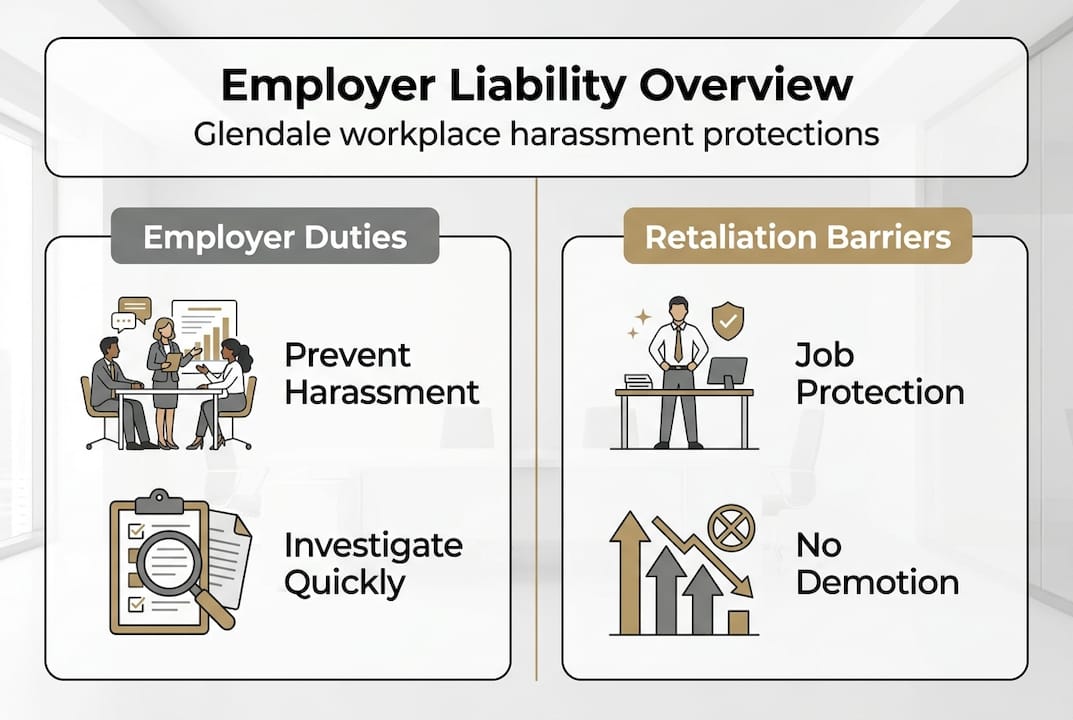
Employer liability for sexual harassment depends on who committed the harassment and how the employer responded. Employers are strictly liable for harassment by supervisors, meaning you do not need to prove the employer knew about or condoned the behavior. This strict liability applies when a supervisor uses their authority to create a hostile environment or demand sexual favors. However, off-site or non-work-related harassment is not directly imputable to the employer unless the employer’s response creates a hostile environment, as clarified in the Kruitbosch case.
If harassment occurs outside the workplace, such as at a company party, industry conference, or even in personal social settings, the employer can still be held liable if the harassment creates a hostile work environment and the employer fails to take corrective action after being notified. For example, if a coworker sexually harasses you at an off-site team dinner and continues the behavior at work, and your employer ignores your complaint, the employer may be liable for allowing the hostile environment to persist.
Retaliation protections are equally robust. Retaliation is prohibited even if the harassment complaint is unsubstantiated, meaning you cannot be punished for reporting harassment in good faith, regardless of whether an investigation proves your claims. Retaliation can take many forms: demotion, termination, reduced hours, negative performance reviews, exclusion from meetings or projects, or escalation of the original harassment.
| Liability Type | Employer Responsibility | Example |
|---|---|---|
| Supervisor harassment | Strict liability regardless of knowledge | Supervisor demands sexual favors in exchange for promotion; employer is liable even if unaware |
| Off-site harassment | Liable if response creates hostile environment | Coworker harasses employee at company retreat; employer liable if they ignore complaint and harassment continues at work |
| Retaliation | Prohibited even if complaint unproven | Employee reports harassment; employer demotes them claiming performance issues; retaliation is illegal |
Recognizing retaliation early strengthens your case. Document any adverse employment actions following your harassment complaint, noting dates and how they differ from your treatment before the complaint. If you receive a sudden negative performance review after years of positive evaluations, or if you are excluded from key projects you previously led, these patterns suggest retaliation.
Key retaliation warning signs:
- Sudden negative performance reviews or disciplinary actions after filing a complaint
- Demotion, transfer to less desirable roles, or reduced responsibilities
- Exclusion from meetings, projects, or professional development opportunities
- Increased scrutiny or micromanagement not applied to other employees
- Termination or constructive discharge (making conditions so intolerable you are forced to resign)
Pro Tip: Recognize and document retaliation signs early to strengthen your legal case. Keep a timeline showing how your employer’s treatment changed after you reported harassment, and gather evidence like performance reviews, emails, and witness statements that demonstrate the shift.
Understanding retaliation after a complaint in California workplaces and signs of workplace retaliation helps you identify illegal conduct and take appropriate legal action.
Legal options and resources for Glendale employees facing sexual harassment
Pursuing legal recourse for sexual harassment begins with filing a complaint with the California Civil Rights Department within 3 years of the incident. This timeline is critical; missing the deadline can permanently bar your ability to sue. The CRD investigates your complaint, may facilitate mediation between you and your employer, and issues a right-to-sue notice if you wish to proceed with a lawsuit. The right-to-sue notice is a prerequisite for filing in court and typically arrives within 60 to 90 days of your request.
| Step | Timeline | Details |
|---|---|---|
| File CRD complaint | Within 3 years of incident | Submit detailed complaint to California Civil Rights Department |
| CRD investigation | 60 to 180 days | CRD reviews evidence, may interview witnesses, and facilitates mediation |
| Request right-to-sue | Anytime after filing | You can request immediately or wait for CRD investigation to complete |
| File lawsuit | Within 1 year of right-to-sue notice | Pursue legal action in civil court with attorney representation |
Most Glendale employment lawyers work on a contingency fee basis, meaning they charge no upfront costs and only collect fees if you win your case. Contingency fees typically range from 33% to 40% of your settlement or judgment, making legal representation accessible even if you cannot afford hourly attorney fees. This arrangement aligns your lawyer’s interests with yours, incentivizing them to maximize your recovery.
Consult lawyers with local Glendale experience, such as firms familiar with Los Angeles County courts and California employment law nuances. Experienced attorneys understand how local judges interpret FEHA, know effective negotiation strategies with Glendale employers, and can connect you with expert witnesses or investigators if needed. Legal action does not require termination of employment; you can pursue claims while still working, though many employees find the work environment untenable and choose to resign or negotiate a separation agreement.
Steps to pursue legal action:
- Document all harassment incidents with dates, times, witnesses, and evidence
- Report harassment internally to HR or designated company officers
- File a complaint with the California Civil Rights Department within 3 years
- Consult a Glendale employment lawyer experienced in sexual harassment cases
- Request a right-to-sue notice from CRD to preserve your ability to file a lawsuit
- File a lawsuit in civil court with your attorney’s guidance if settlement negotiations fail
Understanding important information if you are a sexual harassment victim and reasons why you need to hire an employment lawyer clarifies your options and connects you with the support you need to hold your employer accountable.
Find experienced Glendale sexual harassment lawyers to protect your rights
If you are facing sexual harassment in your Glendale workplace, professional legal guidance is crucial to navigating the complexities of FEHA and Title VII protections. Our experienced Glendale employment lawyers understand how to build compelling cases, negotiate settlements, and litigate aggressively when necessary. We offer consultations to help you understand your rights, evaluate the strength of your case, and develop a strategy tailored to your situation, often with no upfront fees.
Explore detailed guides on understanding sexual harassment laws in California and reasons why you need to hire an employment lawyer to learn how the right legal representation can make a decisive difference. Our firm focuses exclusively on employee rights, never representing corporations, so your interests always come first. Contact us today to get help protecting your workplace rights in Glendale and the greater Los Angeles area, including employment law protections in Los Angeles.
Frequently asked questions
How long do I have to file a sexual harassment complaint in Glendale?
You have 3 years from the harassment incident to file a complaint with the California Civil Rights Department under FEHA. Federal Title VII claims have a shorter 300-day deadline, but FEHA’s longer timeline typically applies in California. Missing these deadlines can permanently bar your ability to pursue legal action, so document incidents promptly and consult a lawyer early.
Can I be retaliated against for reporting sexual harassment in my Glendale office?
No, retaliation is illegal under both FEHA and Title VII. Your employer cannot demote, fire, reduce your hours, or harass you for filing a harassment complaint, even if the underlying claim is not proven. Retaliation protections apply to employees who report harassment internally, file complaints with government agencies, or participate in investigations. If you experience adverse employment actions after reporting harassment, document them immediately and consult a lawyer.
What should I include when documenting sexual harassment incidents?
Include dates, times, locations, specific behaviors or language used, and the names of any witnesses present. Save emails, text messages, voicemails, or photographs that evidence the harassment. The more detailed and contemporaneous your documentation, the stronger your case. Avoid vague descriptions; instead, record exactly what was said or done to provide clear, credible evidence. Proper documentation is often the difference between a successful claim and a dismissed case.
Does sexual harassment outside of work count for employer liability in Glendale?
Off-site harassment is usually not directly imputable to your employer unless it creates a hostile work environment and your employer fails to respond appropriately. For example, if a coworker harasses you at a company event or industry conference and continues the behavior at work, your employer can be held liable if they ignore your complaint. Context matters; courts examine whether the harassment affected your work environment and whether the employer took corrective action.
Do I need to quit my job to file a sexual harassment lawsuit?
No, you do not have to quit your job to file a lawsuit. Many employees continue working while pursuing claims, though some find the work environment intolerable and choose to resign or negotiate a separation agreement. Quitting is not a legal requirement, and doing so prematurely can complicate your case by eliminating evidence or making it harder to prove ongoing harm. Consult a lawyer before making employment decisions to understand how they may affect your legal options.
Recommended
- Workplace Harassment Laws For Glendale You Need To Know
- Sexual Harassment in LA Workplaces: What You Need To Know
- Sexual Harassment by Supervisors in Burbank You Need To Know
- Complete Guide to Sexual Harassment in Baldwin Park
- Anger Management for Employees: Building Workplace Harmony - Mastering Conflict
https://huprichlaw.com/sexual-harassment-glendale-offices-2026-legal-guide/?fsp_sid=2630


Comments
Post a Comment