Worker Misclassification in San Dimas You Need To Know

Uncertainty about your true employment status can leave you feeling exposed in San Dimas, especially when the line between contractor and employee gets blurred. For independent contractors across California, misclassification threatens access to guaranteed wages, overtime, and workplace protections, as clarified by the U.S. Department of Labor’s multifactor test. This article sheds light on the legal differences, risks, and remedies so you can protect your rights and make informed decisions about your working relationship.
Table of Contents
- Defining Independent Contractor Misclassification
- California’s Legal Tests For Worker Status
- Key Differences: Contractors Versus Employees
- Common Pitfalls And Employer Tactics
- Rights, Remedies And Legal Risks For Workers
Key Takeaways
| Point | Details |
|---|---|
| Misclassification Issues | Independent contractor misclassification can lead to financial and legal consequences for both workers and businesses. It affects workers’ rights to minimum wage and benefits. |
| California’s ABC Test | The state employs the ABC Test to determine worker status, requiring proof that the worker is free from control, works outside company operations, and is independently established. |
| Employer Tactics | Employers may manipulate contracts and arrangements to misclassify workers, reducing their obligations regarding taxes and benefits. |
| Legal Remedies for Workers | Misclassified workers can file complaints or lawsuits for unpaid wages and lost benefits, providing several avenues to challenge misclassification. |
Defining Independent Contractor Misclassification
Independent contractor misclassification represents a complex legal issue where workers are incorrectly categorized as independent contractors instead of employees. This misclassification can have significant financial and legal consequences for both workers and businesses operating in San Dimas and throughout California.
The U.S. Department of Labor has established clear guidelines to distinguish between employees and independent contractors. DOL’s worker classification principles emphasize examining multiple factors that determine a worker’s actual employment status. These factors include:
- The degree of control the employer has over work performance
- Whether the work is integral to the company’s core business
- The worker’s opportunity for profit or loss
- The permanence of the working relationship
- The level of skill required for the job
Historically, misclassification has been a persistent problem across various industries. Academic research on labor standards reveals that sectors like construction have long practiced worker misclassification, which undermines labor protections and impacts workers’ economic stability.
Misclassification isn’t just a paperwork issue - it directly affects workers’ rights to minimum wage, overtime pay, workplace protections, and benefits. When companies improperly classify workers as independent contractors, they can avoid paying payroll taxes, workers’ compensation, and providing health insurance.
Pro tip: If you suspect you’ve been misclassified as an independent contractor in San Dimas, document all work arrangements, hours worked, and communication with your employer to build a strong case for potential legal action.
California’s Legal Tests for Worker Status
California has developed some of the most stringent legal tests for determining worker classification in the United States, providing robust protections for workers against potential misclassification. California’s worker classification standards represent a comprehensive approach that goes beyond traditional federal guidelines.
The state primarily utilizes the ABC Test, established through the landmark Dynamex decision and codified in Assembly Bill 5 (AB5). To classify a worker as an independent contractor, employers must prove three critical elements:
- The worker is free from the company’s control and direction
- The work performed is outside the company’s usual business operations
- The worker is independently established in the same type of work
Multifactor Economic Realities Test serves as an additional framework for worker classification. This test examines several key aspects of the working relationship:
- The degree of employer control over work performance
- The worker’s investment in equipment and materials
- The worker’s opportunity for profit or loss
- The permanence of the working relationship
- The skill level required for the job
Legal analysis of worker classification highlights that these tests are designed to prevent businesses from exploiting workers by misclassifying them to avoid providing essential protections and benefits. The burden of proof lies squarely with the employer to demonstrate that a worker genuinely meets independent contractor criteria.
Consequences of misclassification can be severe. Employers found in violation may face significant financial penalties, including back wages, benefits, taxes, and potential legal damages. Workers misclassified as independent contractors can lose critical protections such as minimum wage guarantees, overtime compensation, and workplace safety regulations.
Pro tip: If you’re unsure about your worker classification, request a detailed written explanation from your employer outlining why you’re classified as an independent contractor and compare it against California’s ABC Test criteria.
Key Differences: Contractors Versus Employees
Worker classification fundamentally impacts legal rights, financial responsibilities, and workplace protections. Independent contractor legal definitions reveal critical distinctions that can significantly affect a worker’s professional and financial landscape.
The key differences between employees and independent contractors span several crucial dimensions:
- Control and Supervision
- Employees work under direct employer supervision
- Independent contractors maintain autonomy in work methods
- Payment and Tax Structure
- Employees receive regular wages with tax withholdings
- Contractors invoice for services and manage their own tax obligations
- Benefits and Protections
- Employees receive health insurance, retirement plans, and workers’ compensation
- Contractors typically provide their own insurance and benefits
Practical workplace distinctions highlight the nuanced nature of worker classification. Independent contractors typically possess specialized skills, work for multiple clients, and operate more like small business owners. They negotiate project-based contracts, provide their own tools and equipment, and bear greater financial risk.
Employees, by contrast, are integrated into the company’s core operations. They follow established workplace procedures, receive consistent training, and have their work directly managed by supervisors. The employer controls not just the outcome of work, but also the methods and timing of its completion.
Misclassification can result in significant legal and financial consequences for both workers and employers.
The financial implications of misclassification are substantial. Employees enjoy legal protections like minimum wage guarantees, overtime compensation, unemployment insurance, and consistent income streams. Independent contractors assume more financial uncertainty but gain flexibility in work arrangements.
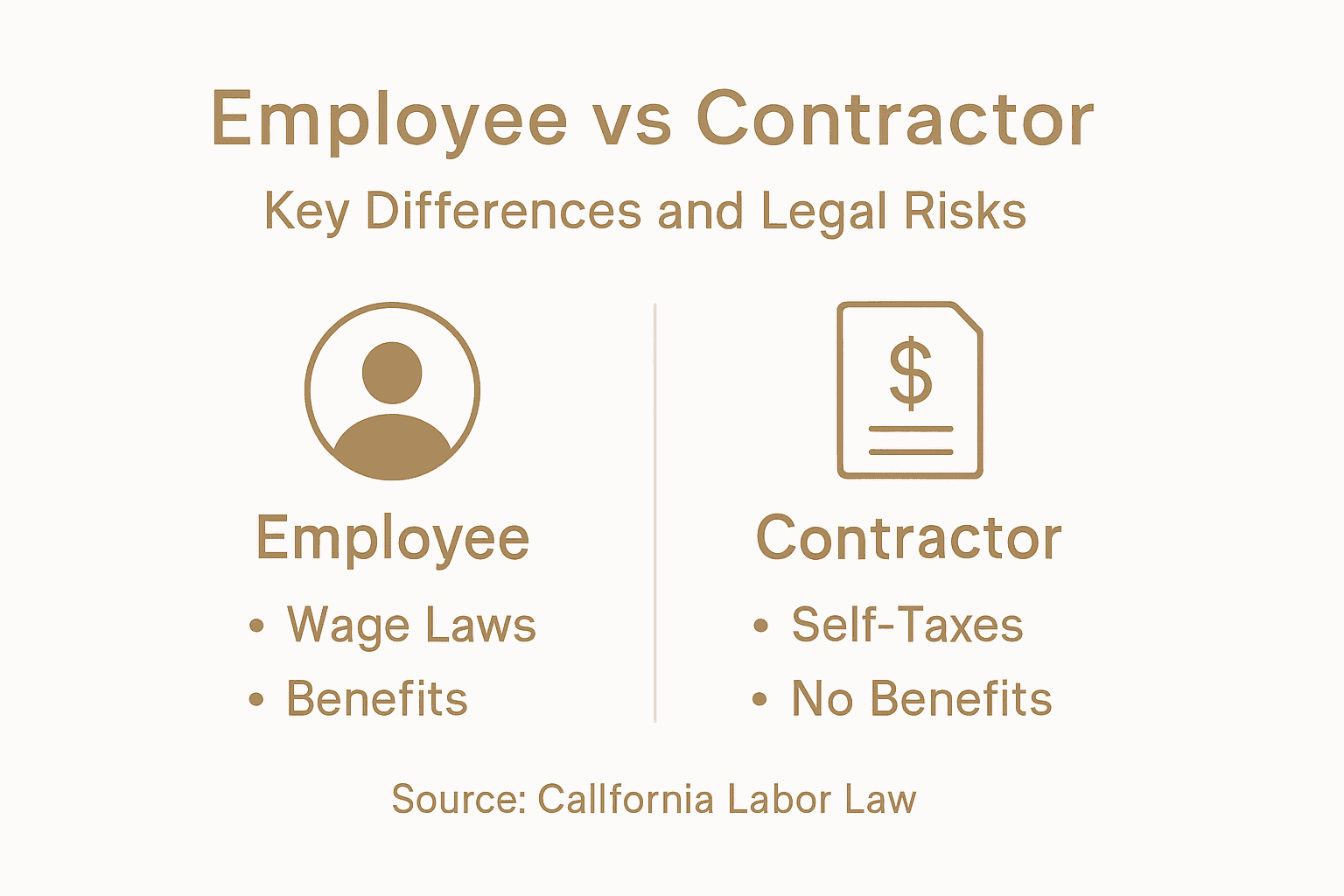
Here’s how contractor and employee classifications impact key areas:
| Area of Impact | Employee Status | Contractor Status |
|---|---|---|
| Legal Protections | Extensive, including wage laws | Limited, fewer mandatory rights |
| Tax Handling | Employer withholds and pays taxes | Worker responsible for own taxes |
| Benefit Access | Health, retirement, unemployment | Must provide personal benefits |
| Job Security | Higher, often long-term roles | Lower, project-based or temporary |
Pro tip: Carefully review your work agreement and actual job responsibilities to determine whether your current classification accurately reflects your working relationship.
Common Pitfalls and Employer Tactics
Worker misclassification represents a systematic strategy many employers use to reduce labor costs and avoid legal responsibilities. Employer misclassification tactics reveal sophisticated methods designed to circumvent worker protection laws.
Employers frequently deploy several strategic approaches to misclassify workers:
- Contract Manipulation
- Creating deliberately ambiguous employment agreements
- Using complex language to obscure true working relationship
- Drafting contracts that artificially designate worker status
- Administrative Strategies
- Splitting worker duties across multiple roles
- Rotating job assignments to complicate classification
- Using temporary or project-based assignments
- Financial Tactics
- Avoiding payroll tax payments
- Eliminating benefit obligations
- Reducing workers’ compensation insurance costs
Legal research on misclassification demonstrates that these tactics often involve deliberate, calculated decisions rather than honest mistakes. Employers may exert significant control over workers while simultaneously claiming they are independent contractors.
Misclassification is not a paperwork error - it’s a calculated strategy to reduce labor expenses and shift financial risks onto workers.
The most sophisticated misclassification techniques involve creating an illusion of worker independence while maintaining substantial operational control. Employers might provide workers with company equipment, mandate specific work hours, require detailed reporting, and dictate precise work methods - all while claiming the worker is an independent contractor.
Financial implications are substantial. Misclassified workers can lose critical protections like unemployment insurance, overtime compensation, and workplace safety regulations. Companies practicing these tactics risk significant legal penalties, including back taxes, fines, and potential civil litigation.

Pro tip: Document every aspect of your working relationship, including communications, assignments, and control mechanisms, to build a strong case if you suspect misclassification.
Rights, Remedies and Legal Risks for Workers
Worker misclassification creates significant legal vulnerabilities for employees in San Dimas and across California. Employment relationship protections ensure workers have multiple avenues to challenge improper classification and recover lost wages and benefits.
Misclassified workers possess several critical legal remedies:
- Administrative Complaint Procedures
- Filing complaints with Department of Labor
- Submitting claims to state labor enforcement agencies
- Requesting investigations into worker classification
- Legal Litigation Options
- Pursuing civil lawsuits for unpaid wages
- Seeking back pay and overtime compensation
- Demanding retroactive employment benefits
- Potential Recoverable Damages
- Lost wage compensation
- Unpaid overtime payments
- Potential punitive damages
Legal research on worker protections reveals comprehensive mechanisms for challenging misclassification. Workers can file claims with the National Labor Relations Board, pursue individual or class action lawsuits, and seek administrative remedies through state and federal labor departments.
Misclassification is not just an administrative error - it’s a violation of fundamental worker rights that can result in significant financial penalties for employers.
Employers face substantial legal risks when misclassifying workers. Potential consequences include administrative fines, back tax obligations, civil litigation expenses, and potential criminal penalties for systematic worker classification violations.
The financial implications extend beyond immediate monetary penalties. Companies found guilty of systematic misclassification can suffer reputational damage, increased regulatory scrutiny, and potential restrictions on future business operations.
Below is a summary of remedies available for misclassified workers and the risks for employers:
| Remedy for Workers | Legal Risk for Employers | Outcome if Proven |
|---|---|---|
| File agency complaint | Administrative penalties | Payment of back wages and taxes |
| Civil lawsuit | Civil damages awarded | Retroactive benefits, potential fines |
| Collective action | Increased scrutiny | Reputational and financial harm |
| Preserve evidence | Higher liability | Strengthening worker legal claims |
Pro tip: Collect and preserve all documentation related to your working relationship, including contracts, communications, and work assignments, to strengthen potential legal claims of misclassification.
Protect Your Rights Against Independent Contractor Misclassification
If you have been misclassified as an independent contractor in San Dimas or anywhere in California you may be missing critical workplace protections and benefits this article highlights the complex challenges and legal risks involved in worker misclassification including loss of minimum wage overtime pay and unemployment insurance. Do not let employers evade their responsibilities or compromise your financial security. Understanding your classification under California’s stringent ABC Test and Economic Realities Test is essential to safeguarding your rights.
At Huprich Law our experienced employment attorneys specialize in fighting back against misclassification and other workplace injustices. We offer a client-centered approach with free consultations and work on contingency fees to ensure you get aggressive representation without upfront costs. Take action now to review your work status and seek remedies such as back pay and benefits owed. Visit Huprich Law to learn more about your rights and schedule your free case evaluation today.
Frequently Asked Questions
What is independent contractor misclassification?
Independent contractor misclassification occurs when workers are incorrectly classified as independent contractors instead of employees, which can lead to the loss of employee rights and benefits.
How can I determine if I am misclassified as an independent contractor?
You can assess your classification by reviewing your work arrangements against the California ABC Test, which includes checking the degree of control your employer has over your work and whether the work is integral to the company’s business.
What are some common tactics employers use to misclassify workers?
Employers may use tactics such as ambiguous contract language, manipulating job duties across multiple roles, and avoiding payroll taxes to misclassify workers as independent contractors.
What legal remedies do misclassified workers have?
Misclassified workers can file complaints with labor departments, pursue civil lawsuits for unpaid wages and benefits, and demand compensation for lost wages and potential punitive damages.
Recommended
https://huprichlaw.com/independent-contractor-misclassification-san-dimas/?fsp_sid=2601


Comments
Post a Comment