Wrongful Termination Checklist 2025: You Need To Know This

Losing your job in California can feel overwhelming and confusing. Over 40 percent of workers who suffered wrongful termination never realize that their firing was illegal. Most people expect paperwork and performance reviews to matter most. The real secret is that timing, quick documentation, and knowing your rights are what actually determine whether you get justice or get stuck with nothing.
Table of Contents
- Key Signs of Wrongful Termination
- Discrimination-Based Termination
- Retaliation and Whistleblower Protections
- Documentation and Evidence Gathering
- Essential Documents to Collect and Preserve
- Professional Performance Documentation
- Communication and Interaction Records
- Termination-Related Documentation
- Taking Action: Steps to Protect Your Rights
- Initial Documentation and Internal Reporting
- Filing Administrative Complaints
- Consulting Legal Professionals
- When to Seek Legal Help in California
- Clear Indicators for Legal Consultation
- Understanding Statute of Limitations
- Selecting the Right Legal Representation
Quick Summary
| Takeaway | Explanation |
|---|---|
| Identify signs of wrongful termination | Look for discrimination, retaliation, or lack of lawful reason in your dismissal. Understanding your rights is essential to protect them. |
| Document everything meticulously | Preserve all performance records, communications, and documentation relating to your termination to substantiate your case effectively. |
| Report issues internally first | Notify your HR department of concerns, creating a formal record that can help in any future legal claims you may pursue. |
| Seek legal help promptly | Consult with an employment attorney if facing legal violations or undue termination, as timing can significantly impact your case. |
| Know the statute of limitations | Be aware of specific deadlines for filing claims in California to avoid forfeiting your legal rights to seek redress. |
Key Signs of Wrongful Termination
Understanding the key signs of wrongful termination is crucial for California employees protecting their professional rights. Wrongful termination occurs when an employer fires an employee for illegal reasons that violate state or federal employment laws. While California is an at-will employment state, workers are still protected from unjust dismissals that infringe on their legal rights.
Discrimination-Based Wrongful Termination
Discrimination remains one of the most significant indicators of wrongful termination. According to Legal Aid at Work, employers cannot legally terminate employees based on protected characteristics such as race, gender, age, disability, national origin, religion, or sexual orientation. For instance, if an employee is fired shortly after revealing a pregnancy or requesting reasonable accommodations for a disability, this could constitute illegal discrimination.
California law provides robust protections against discriminatory practices. An employee might have a strong wrongful termination case if they can demonstrate that their termination was directly linked to a protected characteristic. This includes situations where an employer uses pretextual performance issues to mask discriminatory intent.
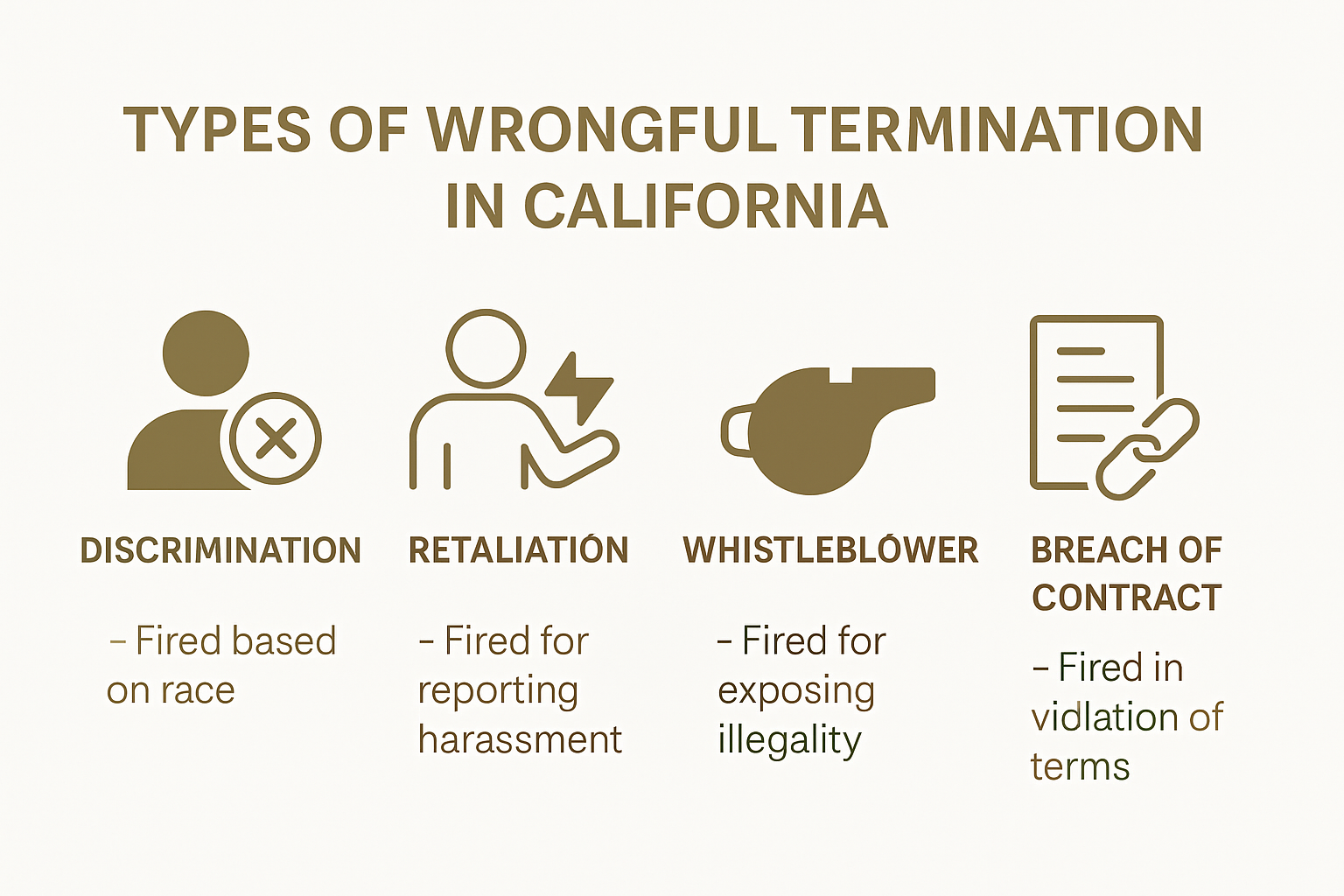
Retaliation and Whistleblower Protections
Retaliation represents another critical sign of wrongful termination. Shouse Law Group explains that employees cannot be fired for exercising their legal rights or reporting workplace violations. This includes scenarios such as:
- Reporting sexual harassment
- Filing a workers compensation claim
- Reporting unsafe working conditions
- Refusing to participate in illegal activities
Whistleblower protections are particularly strong in California. If an employee is terminated after reporting illegal conduct, workplace safety violations, or unethical practices, they may have grounds for a wrongful termination claim.
Wrongful Termination Documentation and Evidence Gathering
LawLinq emphasizes the importance of gathering comprehensive documentation to support a potential wrongful termination claim. Employees should preserve evidence such as:
- Performance reviews
- Email communications
- Witness statements
- Employment contracts
- Detailed timeline of events leading to termination
For California workers who suspect they’ve experienced unlawful termination, documenting every interaction and potential discriminatory or retaliatory action becomes crucial. Contemporaneous notes, saved communications, and a clear chronology can significantly strengthen a potential legal case.
Recognizing these key signs requires a nuanced understanding of employment law. While not every uncomfortable workplace situation constitutes wrongful termination, employees have powerful legal protections against unjust dismissal. When in doubt, consulting with an experienced employment law attorney can help clarify your rights and potential legal recourse.
Below is a table summarizing the main signs of wrongful termination mentioned in this section. Use it to quickly assess areas that may apply to your situation:
| Sign of Wrongful Termination | Examples/Indicators |
|---|---|
| Discrimination | Fired after revealing pregnancy, requesting disability accommodation, or due to protected category |
| Retaliation | Termination after reporting harassment, unsafe conditions, or refusing illegal acts |
| Whistleblower Activity | Fired after reporting illegal conduct or workplace safety violations |
| Documentation Discrepancies | Pretextual performance issues used as justification, absent or inconsistent reviews |
| Sudden Negative Feedback | Unexpected poor performance reviews following protected activity or complaints |
| Lack of Lawful Reason | No legitimate grounds given, especially if unlawful motives are suspected |
Essential Documents to Collect and Preserve
Building a strong wrongful termination case requires meticulous documentation and strategic evidence preservation. California employees facing potential workplace legal challenges must carefully collect and organize critical paperwork that can substantiate their claims.
Professional Performance Documentation
Nolo emphasizes the critical importance of maintaining comprehensive work-related records. This includes gathering all performance reviews, commendations, reprimands, and informal supervisor comments that demonstrate your professional history. Performance documentation serves as a crucial baseline for establishing your work quality and potential motivations behind your termination.
Specifically, employees should preserve:
- Original job descriptions
- Annual performance evaluations
- Written performance improvement plans
- Awards or recognition certificates
- Emails documenting positive work contributions
These documents create a narrative of your professional competence and can help counter potential claims of poor performance used to justify termination.
Communication and Interaction Records
LegalMatch highlights the significance of maintaining detailed communication logs. Employees should systematically collect and organize all workplace communications that might reveal discriminatory practices or retaliatory intent. This includes:
- Work-related email exchanges
- Text message conversations
- Internal messaging platform communications
- Memos and written correspondences
- Meeting minutes or notes
Pay special attention to communications that might indicate potential workplace discrimination, harassment, or inappropriate treatment. Timestamps, full conversation threads, and context become crucial evidence in establishing a potential wrongful termination claim.
Termination-Related Documentation
Yadegar, Minoofar & Soleymani LLP recommend collecting comprehensive termination-related documents. This category includes:
- Official termination letter
- Separation agreements
- Final paycheck details
- Human resources correspondence
- Witness contact information
- Exit interview documentation
Additionally, employees should document the sequence of events leading to termination, including dates, key interactions, and potential witnesses. Creating a detailed, chronological timeline can provide critical context for legal professionals evaluating the case.
Employees must remember that evidence preservation is time-sensitive. Waiting too long can result in lost or destroyed documentation that could be crucial to establishing a wrongful termination claim. Act promptly, organize meticulously, and consult with an employment law professional to understand the full scope of your potential case.
The following table summarizes the essential documents you should collect and preserve as mentioned in this section. Use it as a checklist to organize your evidence:
| Document Type | Examples/Details | Why It’s Important |
|---|---|---|
| Performance Records | Job descriptions, reviews, improvement plans, commendations | Establishes your work quality and disputes poor performance claims |
| Communication Logs | Emails, texts, internal messages, memos, meeting notes | Documents potential discrimination or retaliation |
| Termination Documents | Termination letter, separation agreement, final paycheck details | Provides official record of dismissal and employer’s reasoning |
| HR Correspondence | HR emails, exit interview notes | Shows internal reporting and how your complaints were handled |
| Witness Information | Names and contact details of colleagues present during events | Supports your version of events with corroborating testimony |
| Timeline of Events | Chronological list of incidents, interactions, key dates | Strengthens context and narrative of your case |
Taking Action: Steps to Protect Your Rights
When facing potential wrongful termination, California employees must take strategic and timely actions to protect their professional rights and legal interests. Understanding the correct steps can significantly impact the strength and potential success of a future legal claim.
Wrongful Termination Initial Documentation and Internal Reporting
Equal Employment Opportunity Commission (EEOC) recommends employees first document all incidents of potential discriminatory treatment or workplace violations. This involves creating a detailed, chronological record of events, conversations, and interactions that might suggest unlawful termination.
Employees should consider these critical initial steps:
- Report concerns to human resources department
- Request written documentation of complaints
- Maintain copies of all communication
- Identify potential witnesses
- Preserve email exchanges and workplace communications
Internal reporting provides employers an opportunity to address potential violations and creates an official record of your concerns. This documentation becomes crucial evidence if legal action becomes necessary.
Filing Administrative Complaints for Wrongful Termination
California Department of Fair Employment and Housing (DFEH) outlines specific procedures for filing formal complaints against employers. Employees have strict timelines for reporting workplace violations. In California, workers typically have one year from the date of the discriminatory act to file an administrative complaint.
The complaint process involves:
- Submitting a detailed written complaint
- Providing supporting documentation
- Participating in potential mediation or investigation
- Obtaining an official right-to-sue letter
Workers should understand that administrative complaints serve as critical preliminary steps before potential civil litigation. These formal complaints create official records and may trigger workplace investigations.
Consulting Legal Professionals
California Employment Lawyers Association emphasizes the importance of seeking professional legal guidance early in the process. Employment law attorneys can provide comprehensive evaluations of potential wrongful termination claims, helping employees understand their rights and potential legal strategies.
When consulting an attorney, employees should be prepared to:
- Share all collected documentation
- Provide a detailed account of workplace events
- Discuss potential legal strategies
- Understand potential outcomes and limitations
Legal professionals can help assess workplace discrimination claims and determine the most appropriate course of action. They can also guide employees through complex legal procedures, ensuring all necessary steps are taken within required timeframes.
Taking prompt, strategic action is crucial in wrongful termination cases. Employees must act quickly, document thoroughly, and seek professional guidance to protect their professional rights and potential legal remedies. Remember that time is often critical in employment law cases, and delayed action can potentially compromise future legal options.
The table below summarizes the step-by-step process you should follow to protect your rights after a potential wrongful termination. Refer to it as a process checklist:
| Step | Key Actions | Why It Matters |
|---|---|---|
| Document Incidents | Record events, save emails, keep a timeline | Creates detailed evidence for your claim |
| Internal Reporting | Notify HR, request complaint documentation, identify witnesses | Starts the official record of your concerns |
| File Administrative Complaint | Submit claim to DFEH or EEOC, include supporting documents | Required precursor to legal claims, initiates investigation |
| Seek Legal Counsel | Consult an attorney, share documentation, discuss strategies | Ensures rights are protected and best steps taken |
When to Seek Legal Help in California
Recognizing the right moment to seek legal assistance is crucial for California employees facing potential workplace injustices. Not every uncomfortable workplace situation constitutes a legal claim, but certain circumstances demand professional legal intervention to protect your rights and potential compensation.
Clear Indicators for Legal Consultation
Legal Aid at Work emphasizes that employees should consider legal help when experiencing specific workplace violations. Critical scenarios that warrant immediate legal consultation include:
- Termination after reporting workplace harassment
- Discriminatory treatment based on protected characteristics
- Retaliation for whistleblowing or filing complaints
- Violation of employment contracts
- Consistent pattern of workplace misconduct
These situations often involve complex legal nuances that require professional evaluation. Employment law attorneys can assess the strength of your potential case and provide strategic guidance on navigating potential legal challenges.
Understanding Statute of Limitations for Wrongful Termination
LawHelpCA highlights the importance of timely legal action. California has strict timelines for filing employment-related claims:
- Discrimination claims: One year from the incident
- Wage and hour violations: Three years
- Breach of written contract: Four years
- Breach of oral contract: Two years
Delaying legal consultation can potentially forfeit your right to pursue justice. Prompt action ensures preservation of critical evidence and maintains your legal options.
Selecting the Right Legal Representation
Choosing the appropriate legal representation is as critical as recognizing when to seek help. Learn how to choose an employment lawyer who understands California’s complex employment landscape. Consider attorneys who specialize in:
- Employment discrimination
- Wrongful termination
- Workplace retaliation
- Contract disputes
- Wage and hour regulations
Many employment law firms, including ours, offer free initial consultations. These consultations provide an opportunity to discuss your case, understand potential legal strategies, and determine the most appropriate course of action without financial risk.
Remember that legal help is not just about potential litigation. Skilled employment attorneys can often negotiate settlements, secure severance packages, or resolve workplace disputes through mediation. Your goal should be protecting your professional rights and securing fair treatment.
Taking the first step toward legal consultation can feel intimidating, but it’s a crucial action in defending your workplace rights. California employment laws provide robust protections, and professional legal guidance can help you navigate complex workplace challenges with confidence and strategic insight.

Frequently Asked Questions
What are the signs of wrongful termination in California?
Look for signs such as termination based on discrimination due to race, gender, age, or disability; retaliation for reporting workplace violations or engaging in legal rights; and a lack of lawful reason given for your dismissal.
How can I document my wrongful termination claim?
Preserve performance reviews, email communications, witness statements, and any relevant employment contracts. Create a detailed timeline of events leading to your termination to substantiate your case effectively.
When should I consult a legal professional about wrongful termination?
Seek legal help if you experience termination after reporting harassment, if your dismissal is linked to discrimination based on protected characteristics, or if you suspect retaliation for whistleblowing or filing complaints. Prompt consultation is vital due to statute of limitations.
What is the statute of limitations for filing wrongful termination claims in California?
Employees in California typically have one year from the date of the discriminatory act to file an administrative complaint for discrimination claims, and different deadlines apply to other employment-related issues, with penalties for delays in action.
Take Control After Wrongful Termination in California
Are you worried about being fired for unfair reasons, like discrimination, retaliation or whistleblowing? The “Wrongful Termination Checklist 2025” highlights just how important it is to document your case, spot illegal employer actions, and act within strict California deadlines. You should not have to feel powerless or anxious about lost wages and missed opportunities.
Let Huprich Law Firm stand by your side. Our attorneys have years of experience helping California employees in situations just like yours. From protecting your rights after wrongful termination to fighting for compensation, we take your case personally. If you are ready to move forward, visit our Wrongful Termination resource or explore all employment law services. You can also start now by reaching out directly at huprichlaw.com. Speak to a local expert and protect your future before critical deadlines expire.
Recommended
- What Is Unlawful Termination? What You Need To Know.
- How To File a Wrongful Termination Claim in California
- Wrongful Demotion California: You Need To Know This
- Important Facts You Must Know About Wrongful Termination
https://huprichlaw.com/wrongful-termination-checklist-california-employee-guide/?fsp_sid=2414


Comments
Post a Comment